


In short
- Moonshot AI launched Kimi K3 on Thursday: a 2.8 trillion-parameter open weight model that sits alongside Claude Fable 5 and GPT 5.6 Sol.
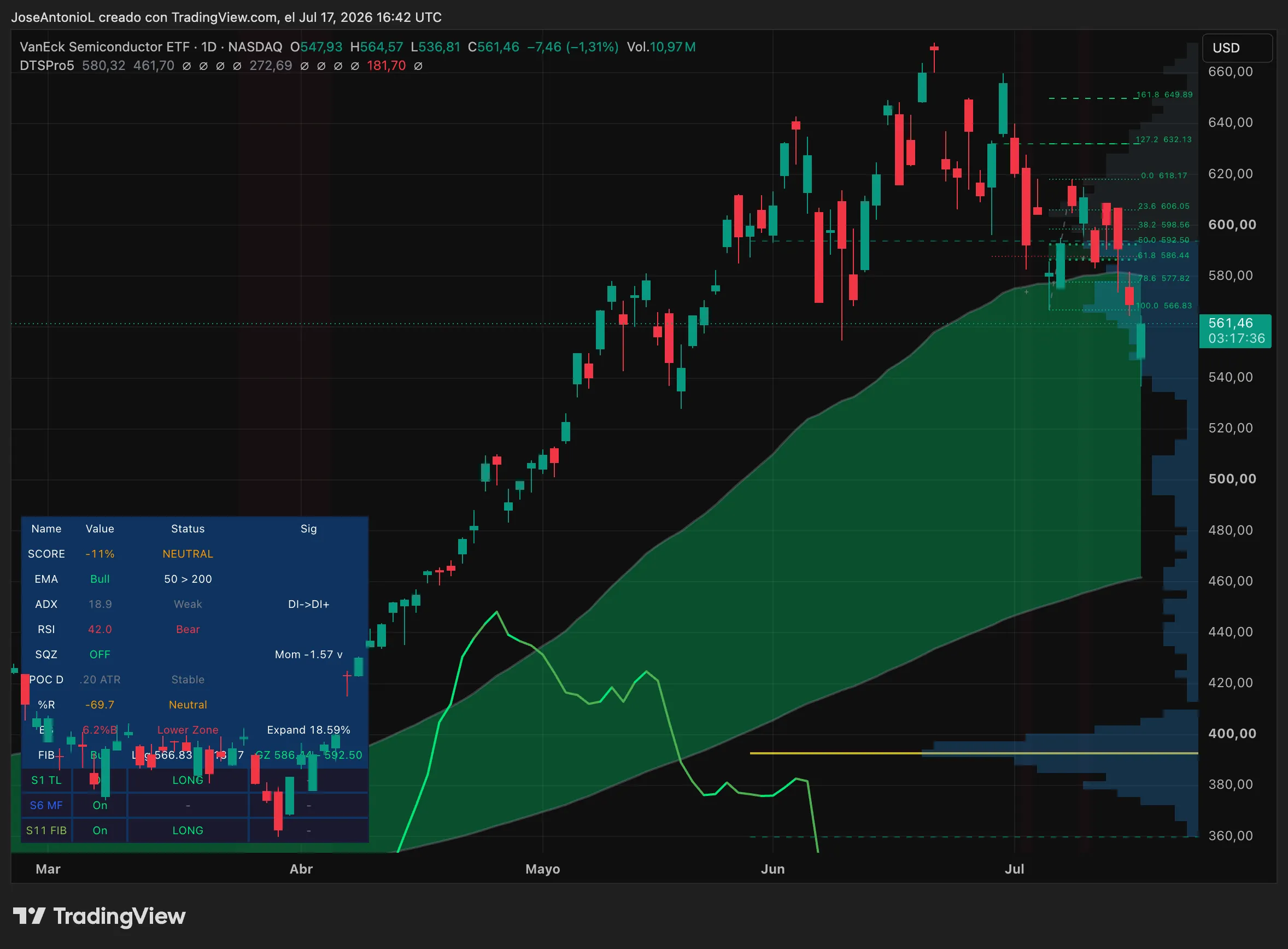
- Semiconductor stocks tumbled on Friday, with the VanEck Semiconductor ETF (SMH) falling below key support for the first time since April.
- The full model weights will be made public on July 27. If they hold up under independent testing, the pressure on US AI companies to justify their infrastructure spending will become significantly harder to ignore.
China did it again. Moonshot AI launched Kimi K3 in the middle of the night and the markets woke up today and did what they always do when a Chinese lab closes the gap: they panicked.
Semiconductor and AI stocks fell across the board on Friday. The Taiwanese benchmark fell more than 6%. Japan closed 4% lower. The Nasdaq fell 1.5%, its worst session of the week.
The DeepSeek comparison seems well deserved. When DeepSeek dropped the R1 in January 2025, the assumption that frontier AI required frontier spending – and the associated chip orders – disappeared overnight. Nvidia lost about $590 billion in market cap in one session. This time the damage spread across the sector.
The VanEck Semiconductor ETF (SMH) fell below its EMA support band – the moving average that tracks price movements in previous months – for the first time since April, extending a run that left it more than 20% below its record high from late June.
On the Artificial Analysis Intelligence Index – an independent composite benchmark that aggregates the performance of models in reasoning, cognition, math and coding – K3 scored 57, which is higher than Claude Opus 4.8 and GPT-5.5, practically on par with Claude Fable 5 and OpenAI’s GPT-5.6 Sol, and beating them in specific benchmarks at a fraction of the price. The full weights will fall under a modified MIT license on July 27, meaning small labs will have that model available for free.
Wall Street analysts largely saw this coming. Bernstein’s Robin Zhu called the release “affirmative” — another data point in a trend that’s been building all year. Morgan Stanley analyst Gary Yu framed Q3 as the product of steady compound progress rather than a shock. “K3 has received positive feedback globally, indicating an overall catch-up of Chinese LLMs with US leaders in model size, performance and pricing,” he wrote.
Bernstein analyst Robin Zhu also took this as a catch-up. “At a high level, K3 feels an affirmation of our beliefs that (1) AI [state of the art] continues to evolve rapidly; and (2) Chinese AI can keep pace with global developments [state of the art]and participate some over time.”
Moonshot is backed by Alibaba, which invested $1 billion in the company in 2024 at a valuation of $2.5 billion. The startup is now valued at approximately $31.5 billion.
As Decrypt reported in May, Moonshot already has deeper roots in US developer circles than most people realize: Cursor’s Composer 2 was found to be running on Kimi K2.5 without disclosure before the Cursor team acknowledged its open-source foundation.
Daily debriefing Newsletter
Start every day with today’s top news stories, plus original articles, a podcast, videos and more.