


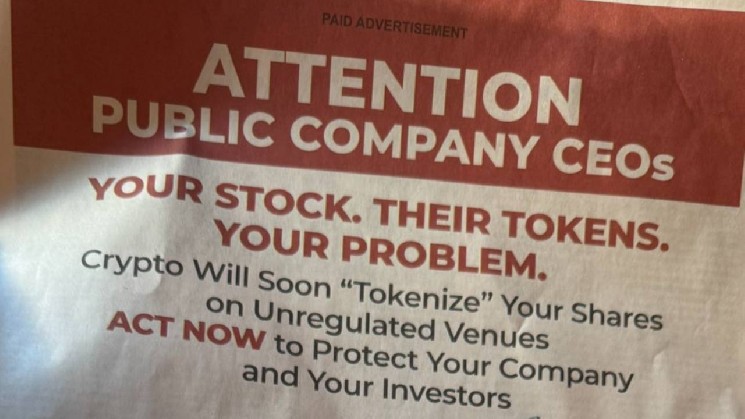
In the ad, the Common Sense Leadership Fund exposes several risks associated with tokenization, including the appearance of price disparities in different token venues, the obfuscation of token owners, impaired ability to raise capital, cybersecurity risks, the possibility of market manipulation, AML/KYC loopholes, and the lack of investor protection for tokenized assets, stressing that CEO’s might be held liable for “anything that goes wrong.”
Carlos Domingo, CEO of Securitize, a public company that lends tokenization services to traditional companies, called the ad’s depiction of the tokenization process “misleading,” stressing that “it mixes tokenization with how it is done and where those tokens trade.”
“None of those concerns apply to proper tokenization done in the US under SEC regulations and traded on regulated venues,” he stressed, highlighting that offshore synthetics, derivatives designed to replicate the economic performance of a stock without ownership, were to blame for these fears.
“I see this as a tailwind for companies like ours doing it the right way, which was never easy, but it’s a durable long-term business model,” Domingo concluded.
MetaleX co-founder and CEO Gabriel Shapiro argued that increased ownership by intermediaries like Robinhood and Coinbase could become an issue, as these could hold real power on contested voting calls where a few percent can decide the outcome.
“Public companies will care about this more than crypto people expect,” he assessed.
Several companies, including Microsoft, Alphabet, Goldman Sachs, Qualcomm, Caterpillar, McDonald’s and Western Digital, have already objected to being listed by OKXICE, a joint venture that applied to act as a Tokenized Security Venue (TSV) under the Securities and Exchange Commission (SEC) Innovation Exemption.