


The ARFC does not specify whether suppliers, the Aave DAO treasury or another recipient would collect those earnings. Its revenue estimate is not a promised increase in suppliers’ deposit rates.
Swept $USDC would still count as supplied liquidity, leaving calculated utilization and borrowing rates unchanged by the transfer. But only $USDC actually held in the Hub would remain immediately available to meet withdrawals and new loans.
Keeping Cash Available
New sweeps could not take total Gateway exposure above the lower of 10 million $USDC or 25% of $USDC supply. Sweeps could not reduce idle $USDC in the Hub below 9% of supply. A separate 5% threshold would trigger recalls aimed at rebuilding that balance toward 9%.
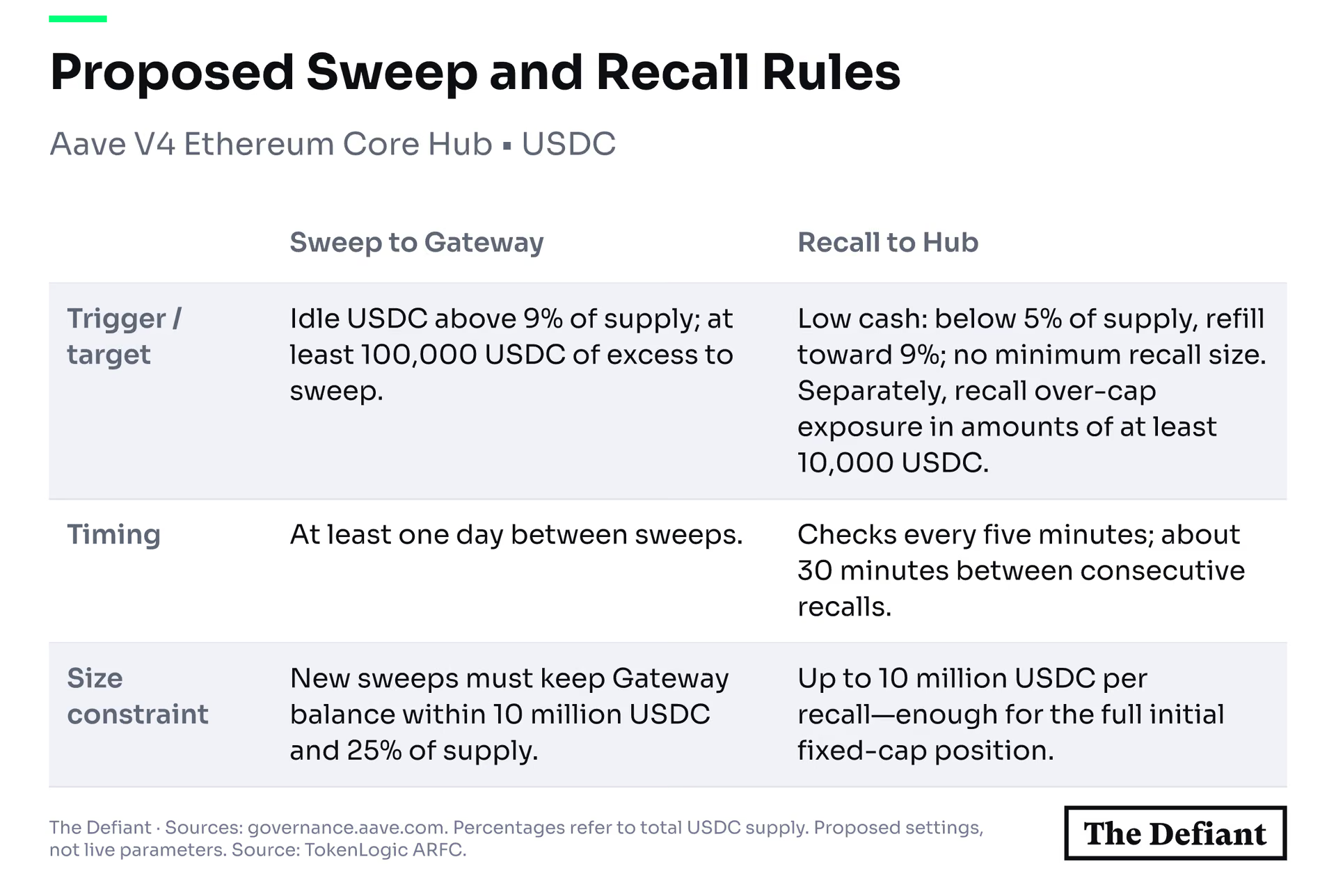
An offchain keeper bot would check liquidity every five minutes. Sweeps would be at least a day apart and require at least 100,000 $USDC of excess liquidity. The contract would enforce the 9% buffer and both exposure caps on new sweeps; the recall threshold and pacing would be keeper settings rather than contract-enforced limits. The keeper would also recall excess if falling supply pushed the existing Gateway balance above the relative cap, subject to a 10,000 $USDC minimum recall size. That minimum would not apply to low-cash recalls.
Gateway withdrawals would be processed one at a time, with about 30 minutes between consecutive recalls and a maximum of 10 million $USDC per recall. Crucially, the initial 10 million $USDC fixed exposure cap matches that maximum: under normal operation, the entire starting Gateway position could be returned in one recall. A larger position would require staged returns if governance later raised the cap.
If Circle’s attestation service—the system authorizing fast redemptions—were unavailable, the proposal says normal recalls could not run. An administrator could pause the controller and use an onchain withdrawal taking about seven days. Circle’s documentation confirms a seven-day withdrawal option that does not depend on its API.
TokenLogic also warns that counting swept funds as supply could weaken the usual interest-rate response to a cash shortage. The Hub could exhaust immediately usable $USDC before reported utilization reaches the steep part of its borrowing-rate curve.
The next steps would be community consensus, a Snapshot vote and, if that passes, an onchain Aave Improvement Proposal to activate and configure the controller. TokenLogic recommends reviewing the parameters after approximately three months of live operation.