


Key takeaways
- US authorities filed a civil forfeiture complaint on November 23 seeking more than $1.1 billion in USDC linked to the October 29 Binance hack, across 36 addresses on 18 blockchains.
- Circle froze the funds but says it cannot technically move them, so it proposes issuing replacement USDC to the US after a forfeiture order.
- Frozen is not recovered: the filings advance the legal-control stage, while final distribution and ownership remain undecided.
- A separate Abu Dhabi court order adds a second jurisdiction, and Circle’s reserve and supply reporting for the replacement tokens will deserve scrutiny.
Nearly four weeks after the Binance hack, US authorities have filed a civil forfeiture complaint seeking more than $1.1 billion in USDC linked to the October theft. The money is already subject to restrictions, but the latest court filings reveal a complication: freezing stolen cryptocurrency is considerably easier than returning it.
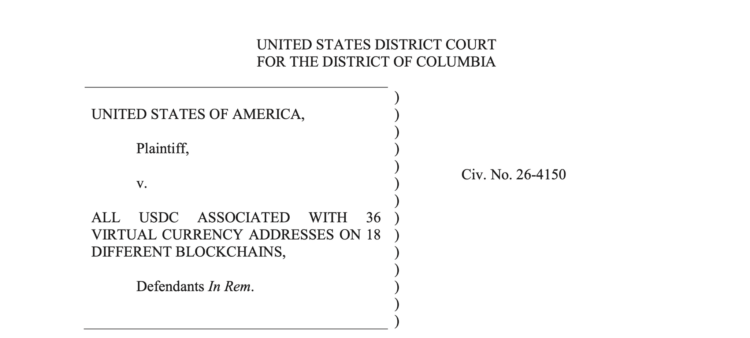
The complaint, filed on November 23, in the US District Court for the District of Columbia, targets USDC associated with 36 cryptocurrency addresses across 18 blockchains.
Federal investigators attribute the October 29 attack to North Korean hacking groups, including the Lazarus Group. The complaint puts the value of the original theft at approximately $6 billion.
For Binance, the latest legal action represents another opportunity to recover a portion of its losses. For the wider cryptocurrency industry, however, the case raises questions about the authority stablecoin issuers exercise over digital assets and what happens when governments become involved.
Binance Hack Recovery Enters a New Legal Phase
The assets targeted by US authorities are not an entirely new discovery.
Earlier this month, NewsBTC reported that Circle had frozen approximately $1.1 billion in USDC linked to the Binance hack, following cooperation with law enforcement.
What has changed is the government’s attempt to establish a legal basis for taking possession of those assets.
According to the court documents, US authorities obtained a temporary restraining order on November 12. Prosecutors subsequently requested that the restrictions remain in place throughout the civil forfeiture proceedings.
Both Binance and Circle consented to the initial restraining order and the requested extension, according to the government’s November 23 application.
The agreement between the companies and federal authorities reduces one immediate obstacle to preserving the funds. It does not, however, resolve the question of their ultimate ownership or distribution.
Civil forfeiture proceedings are directed against property believed to be connected to criminal activity. Interested parties can assert legitimate claims to that property through the legal process.
In this case, prosecutors are seeking forfeiture of the assets to the United States. That is not the same thing as a court ordering their immediate return to Binance.
Circle Cannot Simply Send the Frozen USDC Back
Perhaps the most interesting disclosure in the complaint concerns Circle itself.
The stablecoin issuer can restrict transfers involving USDC held at particular blockchain addresses. However, that authority does not necessarily give Circle direct control over the wallets holding those tokens.
The complaint states that Circle:
“
does not have the technical ability to transfer the Defendant Property from the blocklisted Subject Addresses to the United States
Instead, Circle has agreed to issue an equivalent amount of replacement USDC and transfer those tokens to US authorities upon receiving a forfeiture order from the court.
The proposed arrangement exposes an unusual feature of centralized stablecoins. An issuer can prevent tokens from circulating without possessing the private keys needed to move them.
It also raises an accounting question that deserves attention. If replacement tokens are issued, what ultimately happens to the original frozen USDC, and how will Circle ensure that the treatment of those balances is reflected accurately in its outstanding supply and reserve reporting?
The issuance of replacement tokens would not, by itself, prove that USDC had become undercollateralized. Nevertheless, transparency around the implementation would be important for a stablecoin whose credibility depends on confidence in its backing.
The immediate concern is not whether Circle can create new tokens. It is whether the entire recovery process can be independently accounted for.
The $1.1 Billion Is Not Back With Binance Yet
The temptation to describe the Justice Department’s announcement as a billion-dollar recovery is understandable. It is also premature.
There are three separate stages involved: restricting access to the stolen assets, obtaining legal authority over them and determining how they will ultimately be distributed.
The November 23 filings advance the second stage. They do not establish that the third has been completed.

The $1.1 billion Binance recovery process. Source: US District Court for the District of Columbia filings, November 23, 2026.
There is also a cross-border complication.
On November 18, Reuters reported that an Abu Dhabi court had directed several cryptocurrency companies, including Circle, to preserve digital assets associated with the Binance theft.
The involvement of authorities in both the United States and the United Arab Emirates illustrates how a single cryptocurrency theft can generate legal proceedings across multiple jurisdictions.
Blockchain transactions may cross national borders without much difficulty. Establishing ownership rights over the assets involved is a considerably less straightforward exercise.
That does not mean the US and UAE proceedings are necessarily in conflict. But the ultimate disposition of the funds will require more than an announcement from either government.
For investors assessing Binance’s financial position, the distinction between frozen assets and recovered capital is particularly important. Restricted cryptocurrency should not automatically be treated as money already returned to the exchange.
The Binance Hack Tests the Case for Centralized Stablecoins
For years, the ability of stablecoin issuers to freeze tokens has been criticized by advocates of decentralized finance.
The Binance case demonstrates the other side of that argument.
Without Circle’s ability to restrict transactions, preserving such a large amount of cryptocurrency for potential recovery would have been more difficult.
In this particular case, centralized control has provided a mechanism that may help prevent suspected criminals from benefiting from stolen assets.
The uncomfortable question is whether the cryptocurrency industry can benefit from that authority while also demanding meaningful safeguards against its misuse.
The answer depends partly on transparency. Token holders should be able to understand why assets were frozen, under what legal authority restrictions remain in place and how disputes over ownership are resolved.
The same standard should apply to the exchange, the stablecoin issuer and the government.
The next significant development in the Binance case will be the court’s treatment of the forfeiture claim and any competing claims to the assets. Circle’s proposed issuance of replacement USDC will also deserve scrutiny if it proceeds.
Until then, the $1.1 billion should be understood as assets subject to an ongoing recovery effort, not a completed repayment.
For a cryptocurrency industry that frequently celebrates the speed of moving money, the Binance hack is a reminder that getting it back can be an entirely different business.