



Key takeaways
- Wallets on the official $TRUMP dinner leaderboard held about $9.1 million at the November 16 cutoff, against roughly $148 million for the first dinner in May 2025, a drop of close to 94% in visible dollar value.
- That does not mean 94% of investors withdrew cash: the token price fell sharply, and the two leaderboards are not identical in size or method.
- The top 10 wallets held about 81% of the tokens on the public board, and the top 29 about 95%.
- Public Citizen traced 66 of the 130 displayed wallets to exchanges that restrict US customers, which is not proof about who attended.
Donald Trump’s latest meme coin dinner came with a striking financial comparison: wallets displayed on the official $TRUMP dinner leaderboard held approximately $9.1 million in tokens at the November 16 cutoff, compared with roughly $148 million associated with the first dinner in May 2025. That puts the decline in the publicly measured dollar value at close to 94%. It does not mean investors withdrew 94% of their cash, or that 94% fewer people turned up for dinner.
Trump hosted the third event for major $TRUMP holders at his Virginia golf club on Sunday, November 22. The gathering itself was new, but the more interesting story is what the leaderboard reveals about a token that was once able to turn a private invitation into a market-wide buying contest. NewsBTC previously covered an earlier $TRUMP meme coin dinner rally. This time, the numbers tell a considerably less flattering story about the value attached to that privilege.
What the 94% Figure Actually Measures
The roughly $9.1 million estimate comes from Public Citizen’s November 22 review of the 130 wallets displayed on the final public leaderboard. Its researchers counted 9,794,832.87 $TRUMP tokens and valued them at approximately $0.93 each at the November 16, 9 a.m. Eastern cutoff. The older $148 million comparison refers to the first gala’s leaderboard in May 2025.
Source: Official $TRUMP Gala Dinner Leaderboard (November 16, 2026). Rankings based on time-weighted token holdings. Wallet entries do not necessarily represent individual attendees.
That works out to a decline of roughly 93.9%, rounded to 94%. But the events did not have identical leaderboard sizes or necessarily identical valuation methods. More importantly, the token’s price fell dramatically between the two events. A lower marked-to-market balance can reflect falling prices even if some holders retain comparable token quantities.
Calling this a 94% collapse in new investment would therefore be wrong. The narrower conclusion is still hard to ignore: the value represented by the public competition for dinner access is a small fraction of what it was at the first event.
The leaderboard also should not be mistaken for a headcount. While the public display showed 130 wallets, organizers said 185 wallets qualified under the event’s rules. One person can control multiple wallets, and a wallet can be held for an organization. Neither figure identifies exactly who attended Sunday night’s dinner.
A Few Wallets Still Control Most of the Leaderboard
The smaller overall value is only part of the picture. Public Citizen found that the top 10 wallets held about 81% of the tokens on the public board. The top 29 accounted for approximately 95%. Those top-ranked wallets were also eligible for a special VIP reception.
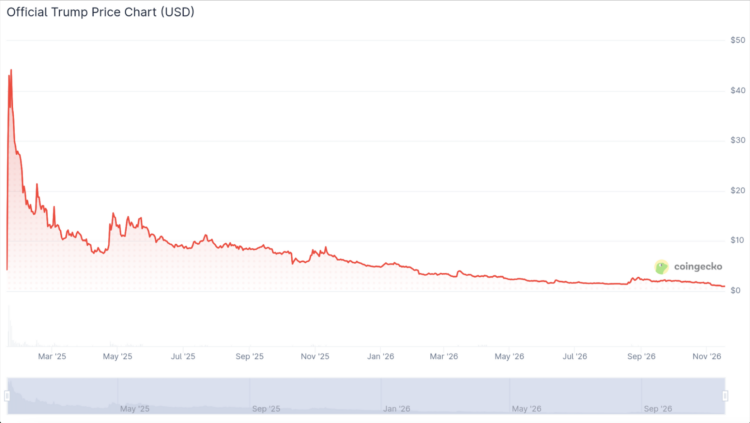
The concentration matters because a leaderboard is marketed as a contest between investors, but its aggregate value can be dominated by a very small number of positions. Looking at the $9.1 million as if it represented broad, evenly distributed enthusiasm would be as misleading as treating all 130 wallet entries as separate people.
There is a revealing detail near the bottom of Public Citizen’s review: the wallet ranked No. 130 held only 9.71 $TRUMP, worth about $9 at the snapshot. It qualified because the competition measured time-weighted holdings over the scoring period, rather than the balance left in the wallet at the very end. That is perfectly compatible with the rules. It also shows why a dinner ranking cannot be read as a simple list of fresh purchases or long-term conviction.
There is another market point here. A buyer who wants dinner access can acquire the token and hedge some of the price risk elsewhere. Holding a spot position long enough to earn a place does not necessarily make someone a directional believer in the coin. In that sense, the competition measures an incentive to qualify, not a clean vote of confidence in future returns.
The Wallet Trail Raises Questions, Not Conclusions About Guests
Public Citizen’s researchers traced 66 of the 130 displayed wallets, or 51%, to direct transfers from exchanges that restrict US customers. Those wallets represented about 4.35 million $TRUMP, roughly 44% of the public board’s token holdings. Among the top 29 VIP-ranked wallets, 15 had received tokens directly from such exchanges, according to the group’s November 22 findings.
That is useful on-chain information. It is not proof that 66 dinner guests were foreign nationals, that all those exchanges served prohibited customers, or that any particular attendee broke a rule. An exchange withdrawal identifies a source of tokens, not a passport or the identity of the person controlling the receiving wallet. Public Citizen put a basic transparency problem plainly: “The names of the invitees have not been disclosed.” That sentence matters because a wallet address, however transparent its transaction history, cannot supply the accountability that a named guest list would provide.
The event’s official website states:
“
GetTrumpMemes.com is not political and has nothing to do with any political campaign or any political office or governmental agency.
That is the organizers’ characterization. It does not remove the transparency question created when holders of a president-linked digital asset can compete for personal access to the president. Neither does that question, by itself, prove an improper exchange of favors.
The Dinner Still Has Value. The Token’s Investment Case Is Another Matter.
There is a credible bullish counterargument. An exclusive dinner is a limited, experience driven reward. Its value to attendees need not move in lockstep with the coin’s market capitalization, and falling token prices can make it cheaper for new participants to qualify. The gala went ahead, and its promoters continue to offer other experiences to holders.
But that is precisely why we should be careful about treating an invitation contest as evidence of a durable investment base. Access is an incentive. It is not a claim on business earnings, and it does not put a floor under the price of the coin.
The most uncomfortable part of this comparison for $TRUMP holders is not that the dinner was smaller or less glamorous. The available figures do not establish either claim. It is that the token’s most recognizable promotional feature remains personal access, while the dollar value visible on the public leaderboard has fallen dramatically since the first event.
In our view, that weakens the argument that repeated celebrity events, by themselves, can sustain the market’s appetite for the token. A more persuasive sign of recovering demand would be durable, independently observable holdings beyond a contest period, with less dependence on a few top-ranked wallets. The next useful data would be post-event wallet balances and exchange flows, measured against the November 16 snapshot, not just another photograph from the dinner.
For now, the 94% comparison is a warning about the dollar value of the visible leaderboard, not proof of a 94% investor exodus. That distinction makes the story more credible, and no less troubling for anyone relying on the dinner promotion as an investment thesis.
Disclaimer: this article is for informational purposes only and is not financial advice.