


This means that miners are increasingly treating their Bitcoin reserves as a source of liquidity to fund business operations and maybe for expansion into AI data centers.
Double trouble for Bitcoin miners
At the same time, there is also a decline in transaction fee revenue. With 11 months into 2026, Bitcoin miners earned just 912 $BTC in transaction fees, the lowest annual total since at least 2011. This is a huge drop compared to 1,720 $BTC in 2025 and 15,178 $BTC in 2024.
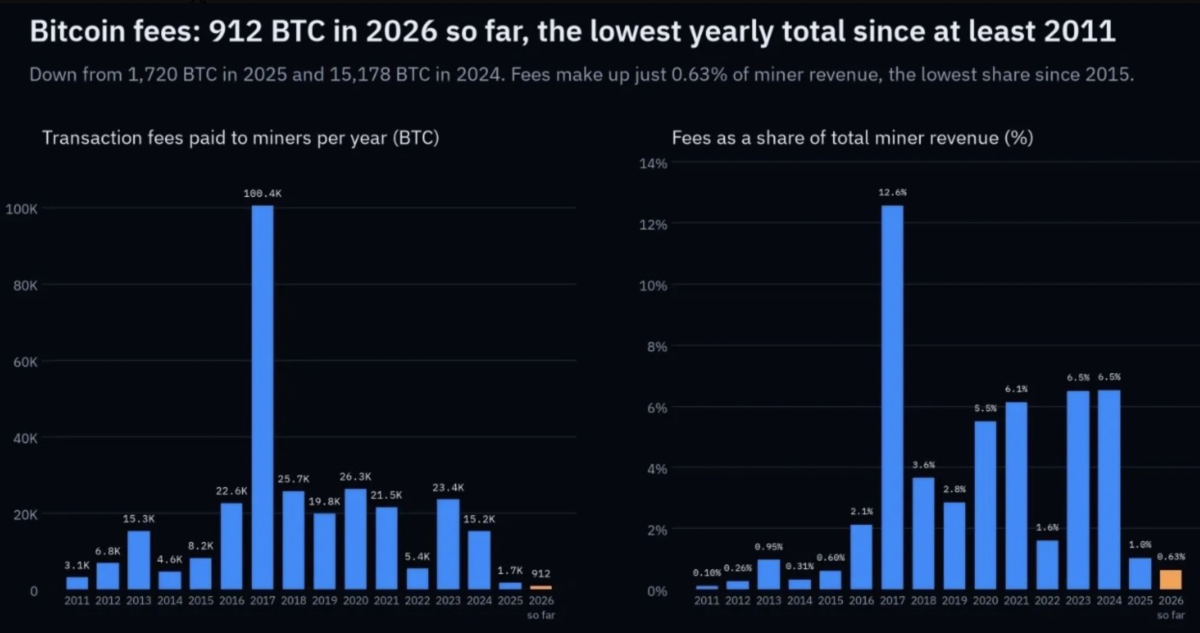
In other words, transaction fees accounted for only 0.63% of total miner revenue in 2026, down from 1% in 2025 and 6.5% in 2023. This is enough proof that demand for Bitcoin block space has weakened, reducing the contribution of this revenue source.
Execs join the fray
Remarking on the same, CleanSpark CBO Harry Sudock said,
Like with any commodity production business, it should get harder and thinner margin over time because the lowest cost operators should be the most successful and durable.
In other words, Sudock believes Bitcoin mining will become increasingly competitive over the next decade, with shrinking profit margins favoring operators with the lowest production and electricity costs.
He expects the global hashrate to continue growing, but at a slower pace than in the previous ten years, as mining hardware becomes more efficient and large publicly listed miners explore AI data centers.
He also argued that Bitcoin mining will not depend solely on large public companies, as smaller businesses and privately held miners can operate profitably.
At the same time, CryptoQuant CEO Ki Young Ju noted that Bitcoin’s average mining cost reached approximately $62,862 in Q3 2026, based on Marathon Digital’s filings. With $BTC trading near this level, miners are facing shrinking profit margins and could face potential losses if prices fall further.
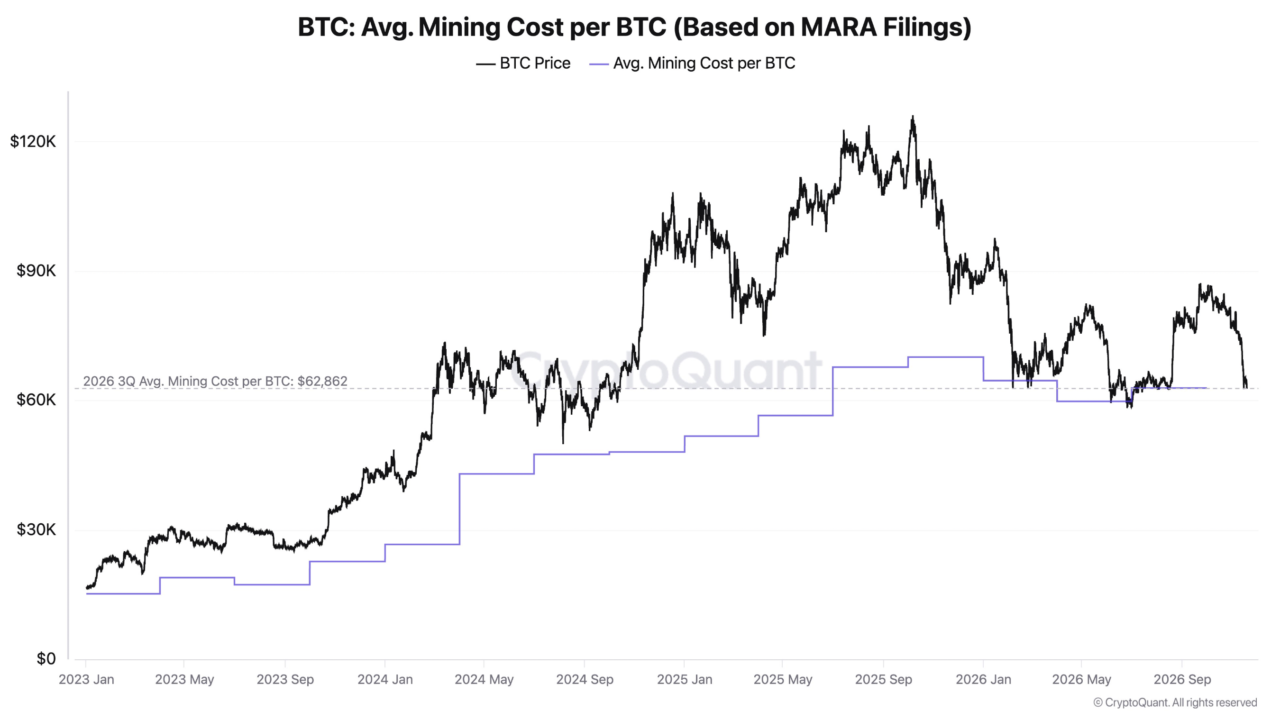
However, the relatively high hashrate suggests miners remain committed to the network despite growing profitability concerns.
Bitcoin miners face a tough time, but…
This comes as Bitcoin miners are shifting their focus towards AI and high-performance computing (HPC), as investors increasingly value their power infrastructure and data centers.
Companies such as Core Scientific, IREN, and TeraWulf are generating significant revenue from AI infrastructure and HPC services, in some cases surpassing their Bitcoin mining income.
However, the Miner Outflow chart suggests that compared with the rest of the year, November outflows are calm.
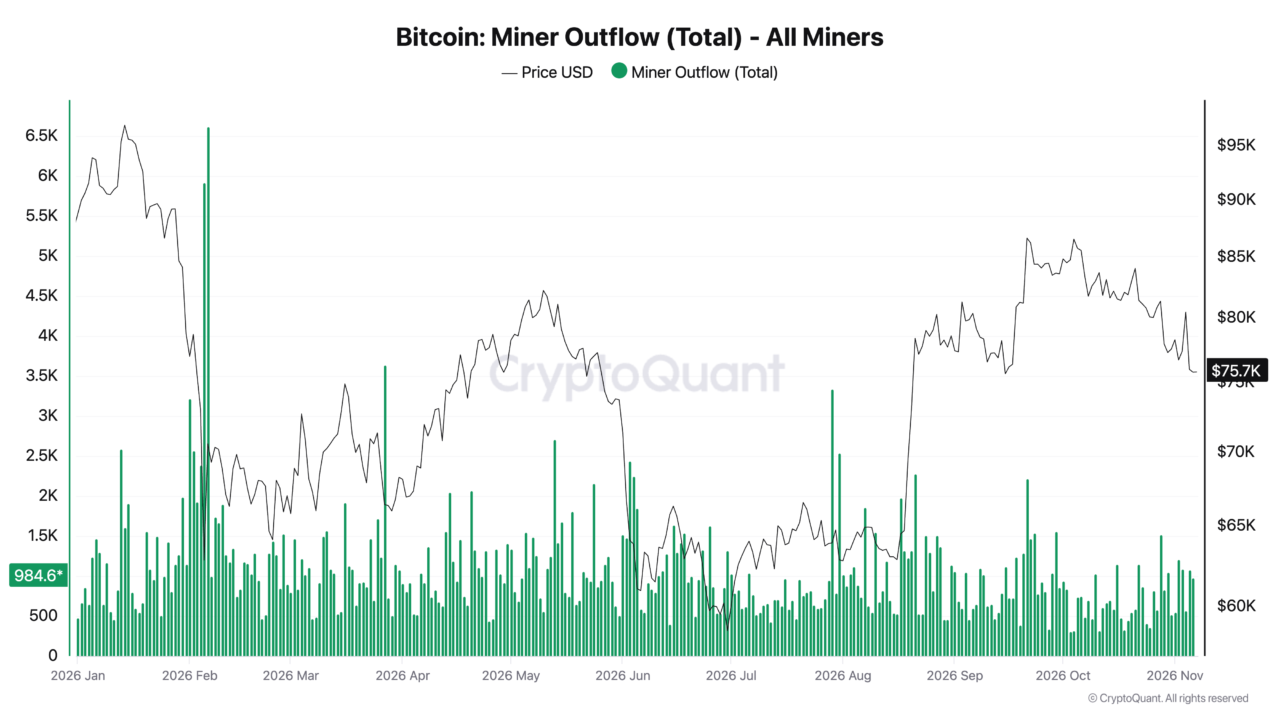
At the same time, the Miner Reserve chart was at about 1.1925 million $BTC at press time. In fact, through October and into November, it moved in a narrow band, roughly between 1.192 million and 1.1926 million.
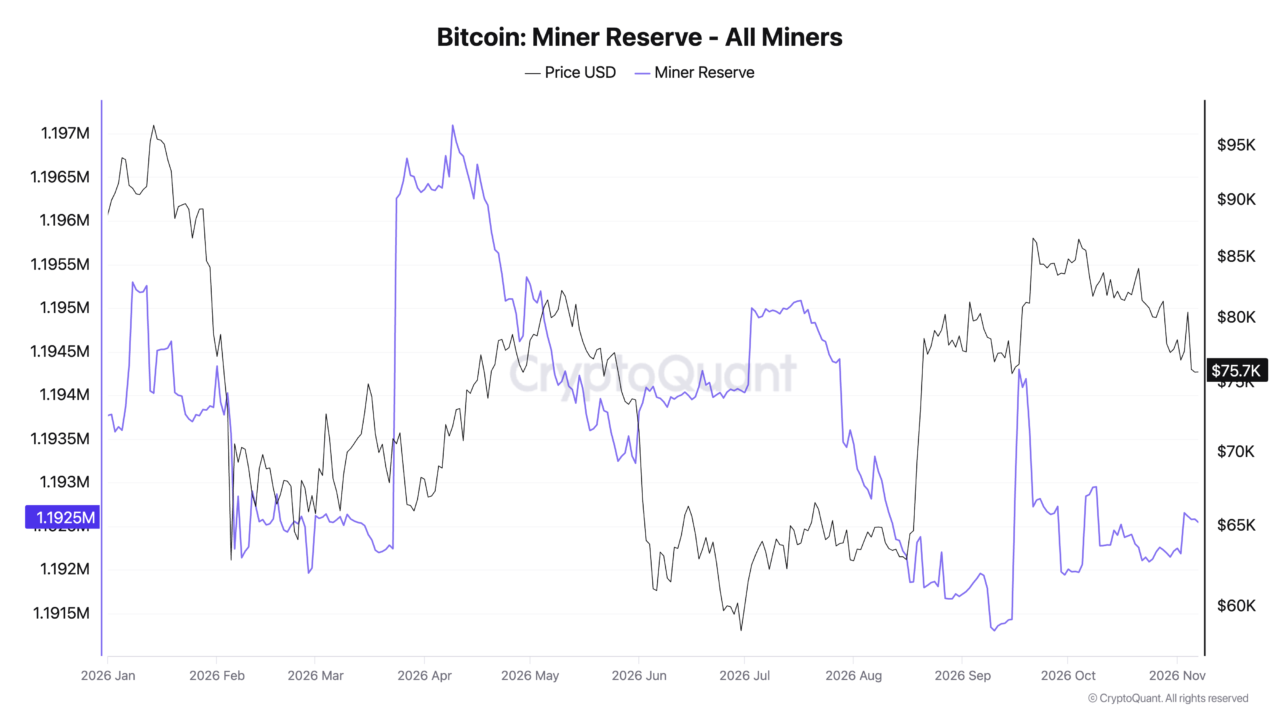
All in all, miners are roughly holding steady, with small accumulation or lower net selling.
Final Summary
- Bitcoin miners earned just 912 $BTC in transaction fees, the lowest annual total since at least 2011.
- Execs believe Bitcoin mining will become increasingly competitive over the next decade, with shrinking profit margins.