


The entrepreneur argued that the market was full of wealthy people who did not understand the nature of investing, while financially literate professionals were left on the sidelines. Instead of assessing account balances, Silbert proposed introducing a government-administered test.
The SEC’s initiative proposes moving to exactly this model.
Under FINRA’s auspices, a publicly available qualification exam is planned. Passing it would allow retail investors to legally participate in venture deals on equal terms with millionaires. Holders of professional credentials such as CFA and CPA designations would receive automatic access.
Are exchanges no longer needed?
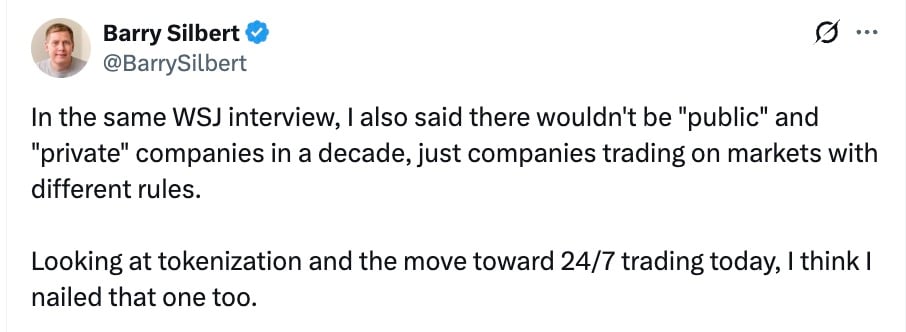
Silbert’s second prediction concerned the structure of corporate capital. Fifteen years ago, he said the strict division between “public” and “private” companies would disappear, giving way to a single digital space where businesses differed only in their trading rules.
In October 2026, this transformation is nearing completion through the large-scale migration of stakes in private companies and investment funds onto the blockchain, giving the private sector seamless liquidity. At the same time, the integration of 24/7 digital platforms has removed secondary-market trading’s dependence on standard exchange sessions.
“Looking at tokenization and the move toward 24/7 trading today, I think I nailed that one too,” Silbert commented on current market trends. Secondary trading in tokens has made investment processes continuous, effectively freeing issuers from the need for a traditional exchange listing and erasing the difference between private startups and public giants.