



That reading showed 347 blocks remaining until the adjustment at block 971,712. Bitcoin recalibrates difficulty every 2,016 blocks to target a ten-minute average block interval. Oct. 16 remains an estimated date, and the projected increase can move as more blocks arrive.
Recent readings have hovered near $40. Crypto reported on Oct. 9 that Hashrate Index hashprice had briefly exceeded $40 before easing to around $39. Luxor’s Oct. 13 analysis put Bitcoin hashprice at $39.71, leaving revenue close to that $40 level ahead of the next retarget.
Higher difficulty reduces the chance that a given amount of computing work earns a block reward. With Bitcoin’s price, subsidy and average fees per block unchanged, the projected rise would take the $39.77 baseline to about $37.63 per PH/day: $39.77 divided by 1.0568.
That is a 5.37% reduction, rather than a 5.68% drop, because revenue scales inversely with difficulty. It isolates the retarget’s effect; actual hashprice will also reflect Bitcoin’s price and fee revenue.
Where electricity cushions could disappear
For illustrative equipment consuming 20 joules per terahash, one PH/s draws 20 kilowatts, or 480 kilowatt-hours over a full day. Dividing revenue by that consumption gives the highest electricity tariff covered by gross revenue alone.
Using Luxor’s energy-adjusted hashprice method, that power-only ceiling falls from 8.29 to 7.84 cents per kWh in the scenario. Lower joules per terahash means less electricity used for the same computing output.
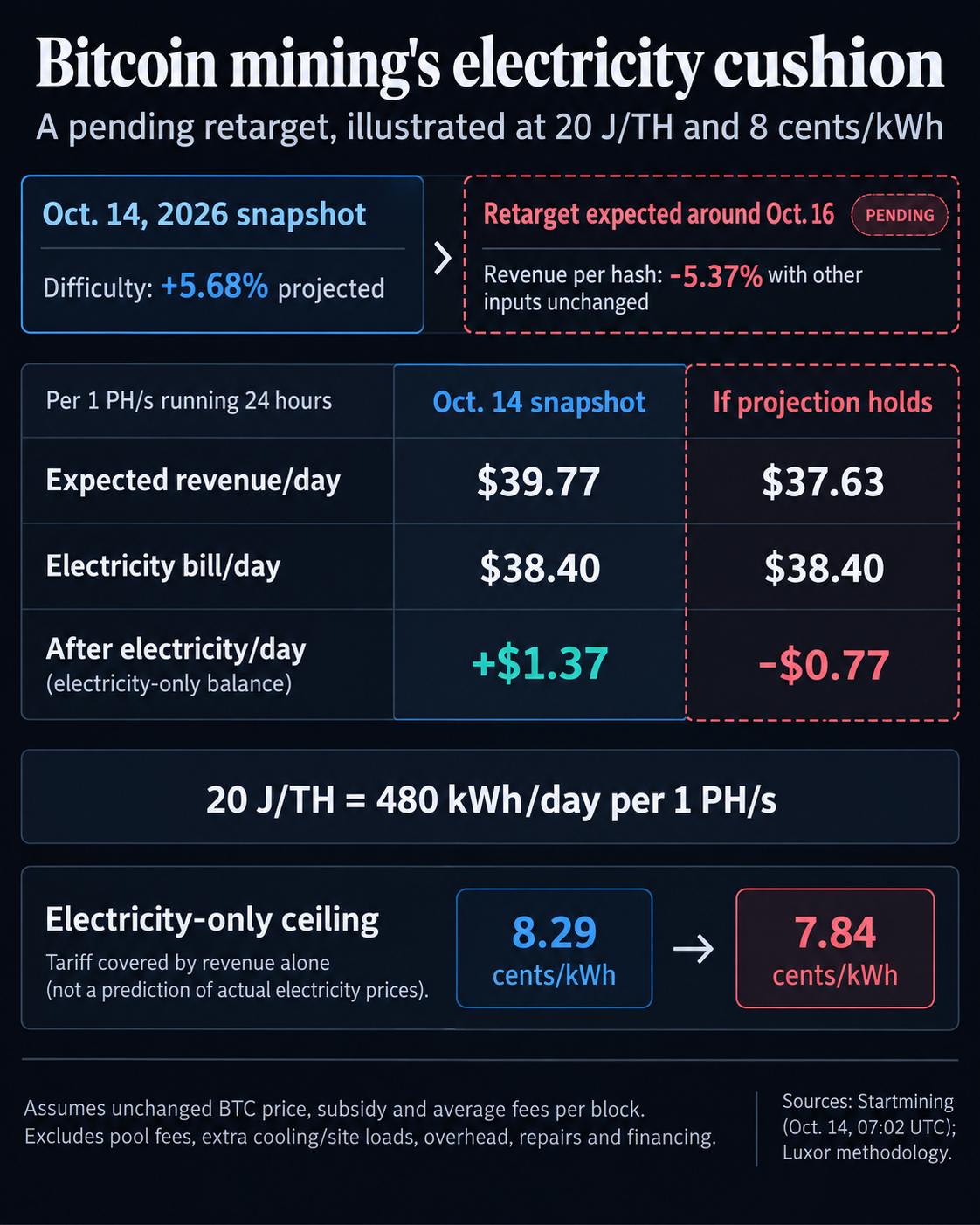
The table assumes continuous operation and unchanged Bitcoin price, subsidy and average fees per block. Its electricity-only ceilings exclude pool fees, separate cooling and site loads, repairs, overhead and financing.
Equipment at 25 J/TH paying 6.5 cents per kWh, or 30 J/TH paying 5.5 cents per kWh, crosses the same threshold. At 15 J/TH and 8 cents per kWh, an electricity cushion remains.
The next test is the completed adjustment at block 971,712 and hashprice afterward. A higher dollar value of rewards per block could soften the squeeze; a lower value would deepen it.