


In short
- California orders stricter safeguards for AI companies seeking state contracts.
- The move comes as the Trump administration pushes national AI standards.
- State officials will develop procurement rules that address issues of bias, abuse and civil rights risks.
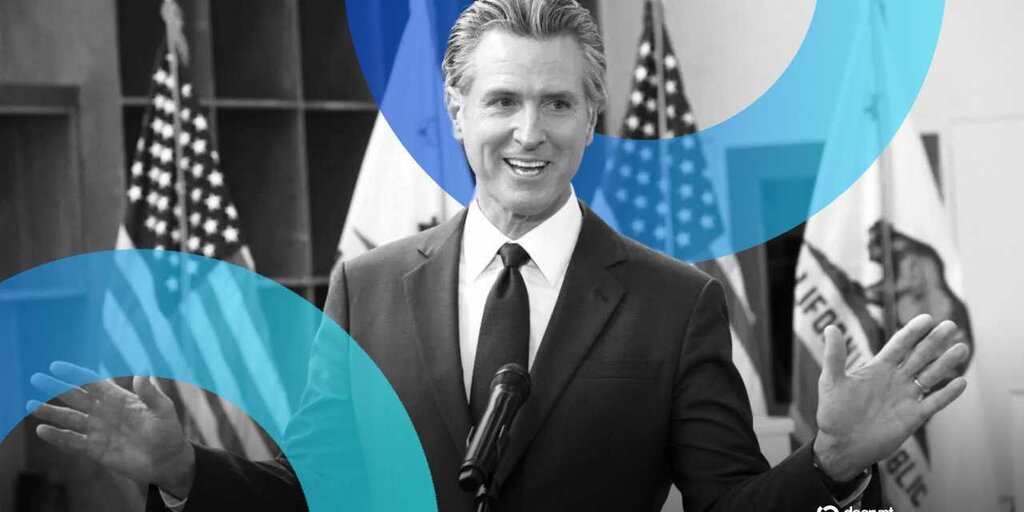
The conflict between Washington and the states over artificial intelligence policies escalated Monday after California Governor Gavin Newsom signed an executive order requiring stronger safeguards for AI companies seeking state contracts.
According to the orderCompanies that sell AI systems to California agencies will be required to demonstrate policies that prevent misuse and protect privacy, security and civil rights.
“California has always been the birthplace of innovation. But we also understand the downside: In the wrong hands, innovation can be misused in ways that put people at risk,” Newsom said in a statement. “California is a leader in AI, and we’re going to use every tool we have to ensure companies protect people’s rights, not exploit them or endanger them. While others in Washington craft policies and contracts in the shadow of abuse, we’re focused on doing it the right way.”
Newsom’s order directs the state’s Government Operations Agency to develop procurement standards for AI vendors that address issues such as illegal content generation, model bias, and risks to civil rights and freedom of speech. The order also directs the California Department of Technology to develop recommendations for watermarking AI-generated images and manipulated video.
The order puts California at odds with the Donald Trump administration’s efforts to set national AI standards and limit state-level regulations. Earlier this month, the Trump administration released a national policy framework for artificial intelligence, calling on Congress to set federal standards and reduce what officials described as a patchwork of state AI regulations.
Kevin Frazier, an adjunct scholar at the Cato Institute, said the dispute reflects a long-standing constitutional balance between state and federal authority.
“Every technological breakthrough – from the steamboat to superintelligence – raises important questions about how regulatory powers should be divided between the states and the federal government,” Frazier told me. Declutter. “The Constitution provides a clear answer: the federal government must take the lead on economic and national security, as well as on issues that require a uniform response; states can exercise their traditional police powers within their borders.”
Frazier called Newsom’s executive order “a great example of federalism in action” and said companies that reject California’s demands can choose not to sell to the state.
“Meanwhile, Congress is still in a position to set the terms for the pace and direction of the country’s AI ambitions,” he said.
Quinn Anex-Reis, a senior policy analyst at the Center for Democracy and Technology, said California’s size and purchasing power could affect how companies design and test AI systems if they want to sell to the state.
“Government contracts are very valuable for companies,” Anex-Reis said Declutter. “It’s a big part of the business for technology developers in general, and a growing business for AI developers in particular.”
He said procurement rules are one of the most effective ways governments can shape how AI systems are developed and evaluated.
“The purchasing process is a very important point to pay attention to,” says Anex-Reis. “Because that’s really the most important place the state can look to create protections and expectations for how vendors develop their tools.”
Newsom has emerged as a national Democratic figure and potential 2028 presidential candidate. A recent Politico-UC Berkeley Citrin Center poll found him leading former Vice President Kamala Harris by 14 points among California’s likely Democratic primary voters.
The policy clash over AI regulation puts him in direct conflict with the Trump administration as debates intensify over who should set the rules for the technology. Last summer, the Trump administration ordered federal agencies to avoid contracts with what it called “woke AI” models and to purchase systems that demonstrate ideological neutrality.
Nevertheless, Anex-Reis said the question surrounding AI regulation outweighs the political one.
“This really shouldn’t be a political issue,” Anex-Reis said. “It’s really about making sure taxpayers’ money isn’t wasted and that the tools our government buys work.”
Daily debriefing Newsletter
Start every day with today’s top news stories, plus original articles, a podcast, videos and more.